

Table of Contents
- The Australian Coin Grading Scale Explained
- How to Grade Your Own Coins: A Step-by-Step Workflow
- Numismatic Grading Tools Every Beginner Should Own
- PCGS Grading Australia: When Third-Party Certification Is Worth It
- The Impact of Cleaning on Value: What Not to Do
- Macro-Photography Techniques for Grading
- Storage and Preservation for Graded Coins
- Conclusion
- Frequently Asked Questions
Last Updated: September 26, 2026
The Australian Coin Grading Scale Explained
Grading Australian coins is the practice of assessing a coin's condition on a standardised scale to determine its wear, eye appeal and market value. For anyone grading Australian coins for beginners, the place to start is the local scale: a set of descriptive grades that runs from Poor through to Gem Uncirculated, each tied to how much detail remains on the coin's highest points.
From Poor to Gem Uncirculated: What Each Grade Means
The Australian scale uses descriptive terms rather than numbers. Each grade describes how much of the original design remains, how much mint luster survives, and how many marks the surface carries.
| Grade | Abbreviation | What It Looks Like |
|---|---|---|
| Poor | P | Barely identifiable; date may be worn flat |
| Fair | FR | Design outline visible, heavy wear throughout |
| Good | G | Major features readable, significant flatness |
| Very Good | VG | Clear design, all legends legible |
| Fine | F | Moderate wear on high points, some detail intact |
| Very Fine | VF | Light wear, most detail sharp |
| Extremely Fine | EF | Only slight wear on highest points |
| About Uncirculated | aUNC | Trace wear, near-full luster |
| Uncirculated | UNC | No wear, may show bag marks |
| Gem Uncirculated | Gem UNC | Full luster, exceptional eye appeal |
How the Australian Scale Differs from the Sheldon Scale
The Sheldon scale, used widely overseas, assigns numbers from 1 to 70. The Australian descriptive system maps loosely onto it, but the two are not interchangeable. A coin described as Extremely Fine locally may sit at a different Sheldon number depending on the grader's interpretation of luster and surface quality.
How to Grade Your Own Coins: A Step-by-Step Workflow
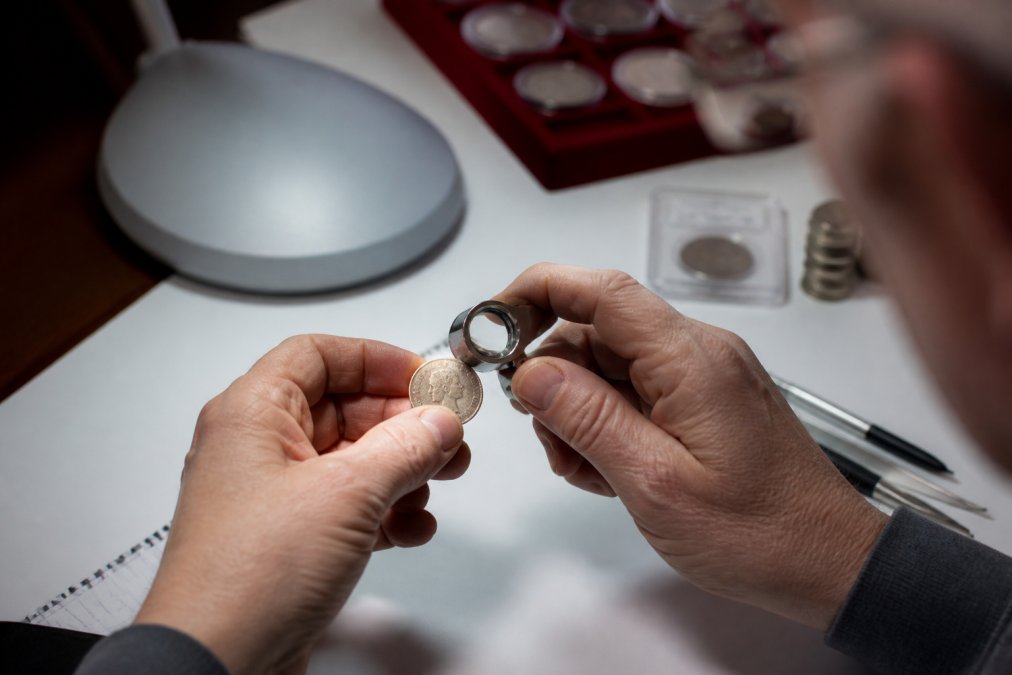
Start by grading under consistent conditions: the same lamp, the same background, the same magnification. Consistency matters more than equipment, because your eye calibrates to whatever it sees most often. Then work through the coin systematically rather than glancing at it and guessing.
The Seven-Step Pass
- Examine the obverse and reverse under angled light. Tilt the coin so the light rakes across the surface. Flat, diffuse light hides hairlines; angled light exposes them.
- Identify the high points, the raised areas that wear first. On many Australian designs that means the monarch's ear and hair, the kangaroo's hindquarters, or the raised lettering of the legend.
- Check the rim for bumps, nicks and flattening. A coin with a perfect centre but rim damage grades lower than its surface suggests.
- Note surface marks: bag marks, hairlines, toning, and any sign of cleaning.
- Assess remaining luster across the fields. Luster is the cartwheel effect that survives on undisturbed metal; its absence on a supposedly uncirculated coin is a red flag.
- Assign a grade, then re-check against a reference image. Do this every time, even when you are confident.
- Photograph the coin and record your grade before storage, so you have a dated record of your own judgement.
Worked Example: Grading a Florin
Take a pre-decimal florin with a clear date and full legend. Under angled light you notice the monarch's ear is flat and the hair detail has merged into a smooth mass, but the legend is fully sharp and the rim is unbroken. There is no luster left in the fields, and a faint scratch runs across the reverse.
Reading Wear Patterns, High Points, and Rim Condition
The high points are where a coin's design sits highest above the field, and they wear first. Learn the high points of the specific series you collect, they differ between pre-decimal and decimal issues, and between one monarch's effigy and another's.
Proof vs Circulation Strikes: What Beginners Need to Know
A proof coin is struck with specially prepared dies and polished blanks, producing a mirror-like field and a frosted design (Coin Collecting Glossary). A circulation strike is made for everyday use and carries a normal, satin finish.
Test Yourself Before You Trust Yourself
Once you have worked through a handful of coins, cover the labels on your reference images and grade from the picture alone. Then reveal the answer. This simple drill, grade, reveal, compare, builds calibration faster than reading about grades ever will, and it costs nothing but a printed sheet of reference images.
Numismatic Grading Tools Every Beginner Should Own
You do not need a laboratory. A small, well-chosen kit covers almost everything a beginner will encounter.
- A 10x jeweller's loupe for surface inspection
- A bright, adjustable desk lamp for angled lighting
- Cotton gloves to avoid fingerprints on uncirculated coins
- A soft mat or tray so coins never touch hard surfaces
- A reference guide with clear photographs of each grade
- A camera or phone with macro capability for records
PCGS Grading Australia: When Third-Party Certification Is Worth It
Third-party certification means an independent grading company examines, authenticates and encapsulates your coin, then issues a certificate recording the grade. The holder, commonly called a slab, seals the coin so it cannot be handled, cleaned or swapped without breaking the seal. That seal is the whole point: it converts one person's opinion into a verifiable, transferable record.
Who Actually Grades Coins Locally
Two names dominate the Australian market, and beginners should understand the difference before submitting anything.
- PCGS operates a local submission service through authorised dealers and a local office, so coins do not have to leave the country to be graded. Its holders are widely recognised by buyers.
- NGC also grades Australian coins and is accepted by most dealers, though submissions typically route overseas, which adds freight and turnaround time.
- ANDA-affiliated dealers and local numismatic societies can often arrange submission on your behalf and will advise whether a coin is worth the fee at all.
What Submission Actually Involves
A typical submission requires the coin in a protective holder, a completed submission form, declared values, and payment of a tiered fee based on turnaround speed and the declared value of the coin. You choose a service tier; faster tiers cost more. Coins are returned in slabs with a certificate number you can verify against the grader's online database.
Two practical points beginners miss:
- Declared value drives your fee and your risk. Under-declaring to save money leaves you under-insured if the parcel is lost in transit.
- Not every coin is worth submitting. Postage, insurance and the grading fee are fixed costs. On a common circulated coin worth a few dollars, the fee will exceed the coin's value several times over.
A Simple Worth-It Test
Before submitting, ask three questions:
- Is the coin a key date, a recognised variety, or genuinely high grade?
- Is there any doubt about authenticity that a slab would resolve?
- Will the expected uplift in buyer confidence and resale price comfortably exceed the total cost of grading, postage and insurance?
If the answer to all three is no, keep the coin raw in an inert holder and spend the money on reference material instead.
Where Certification Fits in Your Learning
Certification is a shortcut to confidence, not a substitute for skill. The most useful habit is to buy a small number of certified coins across a range of grades, then study them raw through your loupe. Seeing what an Extremely Fine coin actually looks like under magnification teaches your eye faster than any label can, and it means you will eventually be able to judge a raw coin before you pay for anyone else's opinion.
The Impact of Cleaning on Value: What Not to Do
Cleaning a coin almost always reduces its value, sometimes dramatically. Abrasive polishes strip the original surface and leave hairlines that a grader spots instantly. Even gentle chemical dips can dull luster and leave an unnatural, flat appearance.
Macro-Photography Techniques for Grading
Macro photography lets you compare coins consistently and document your grades. It also reveals flaws your eye skips at arm's length.
Storage and Preservation for Graded Coins
Graded coins need stable conditions. Fluctuating humidity encourages toning and, on some metals, corrosion. Keep slabs and raw coins out of direct sunlight, which fades the surfaces of some issues, and away from heat sources.
Conclusion
Learning to grade is the single skill that protects a collector from overpaying, and it takes practice rather than expensive equipment. Start with the descriptive scale, work through the step-by-step workflow, and resist every urge to clean.
Frequently Asked Questions
What are the standard grading scales for Australian coins?
Australian coins use a descriptive scale from Poor through to Gem Uncirculated, with key grades including Very Good, Fine, Extremely Fine, About Uncirculated, and Mint State. This scale focuses on wear patterns, surface marks, and eye appeal. It differs from the American Sheldon numeric scale, though many Australian dealers and collectors cross-reference both when buying or selling pre-decimal and Commonwealth coins.
Is it worth getting Australian coins professionally graded by PCGS?
PCGS grading Australia services are worth it for coins with a market value high enough to justify the fee, typically key dates, rare varieties, or high-grade Mint State pieces. For common circulated coins, self-grading with numismatic grading tools is sufficient. Professional certification adds authentication and a guaranteed grade, which helps when selling to buyers who cannot inspect the coin in person.
What is the difference between Australian grading standards and the Sheldon scale?
The Australian coin grading scale uses descriptive terms like Very Good, Extremely Fine, and About Uncirculated. The Sheldon scale uses numbers from 1 to 70, where 70 is perfect. Australian dealers often map descriptive grades to Sheldon equivalents for consistency, but the descriptive system remains the standard for pre-decimal and Commonwealth coins in local catalogues and auctions.
How do I identify the grade of a circulated Australian penny?
Start by examining the high points, which are the king's or queen's ear and the central diamond on the reverse. Check for wear patterns, rim bumps, and surface marks. A penny with clear details but flattened high points is typically Fine to Very Fine. One with sharp details and only slight wear on the highest points grades Extremely Fine or better. Use a loupe and good lighting for accuracy.
What tools do I need to start grading coins at home?
You need a 10x magnifying loupe or jeweller's loupe, a soft white cotton glove to avoid fingerprints, a bright adjustable desk lamp for angled lighting, and a clean lint-free cloth or tray to rest coins on. A coin grading guide or app helps with reference images. Avoid handling coins by their faces; hold them by the rim only to prevent surface marks and preserve luster.
Does cleaning a coin affect its value?
Cleaning almost always reduces value. It strips natural patina and toning, leaves hairlines under magnification, and can cause permanent surface damage. Collectors and certification services can detect cleaning damage easily, and a cleaned coin may sell for significantly less than an uncleaned example in the same technical grade. Never polish, rub, or use chemicals on any coin you plan to keep or sell.